
Table of Contents
Primary keyword: Google ranking without an index
Meta description : Google ranking without an index is still research, but it could change SEO. See what the DeepMind paper says and 4 easy steps to stay visible this week.
URL slug: google-ranking-without-an-index
Google ranking without index may seem like something only search engine architects care about. It is not. If you have a site, have an SEO professional team, or simply rely on Google to find potential clients – this one is for you.
Here is the TL;DR. According to the DeepMind paper published in January 2026, theoretically, a single language model can rank any number of documents without a specialized index. Duane Forrester commented on this discovery in Search Engine Journal on October 8, 2026. In short, he says that the system produces a ranked list that is no longer interpreted as a search result by people but is processed internally within the algorithm to reach the end result.
I am a freelance online marketer with years of experience in digital promotion, SEO, and content creation. When I first heard about Google ranking without an index, I was surprised and concerned about the future of online marketing and SEO.
After thinking about it, I realized there was no need to panic. Instead, I wanted to understand what this development could mean for businesses and SEO professionals.
As a professional in this field, I believe it is important to analyze the research and explore practical ways to adapt. In this article, I share my thoughts on Google ranking without an index and its possible impact on SEO.
What Google Ranking Without an Index Actually Means
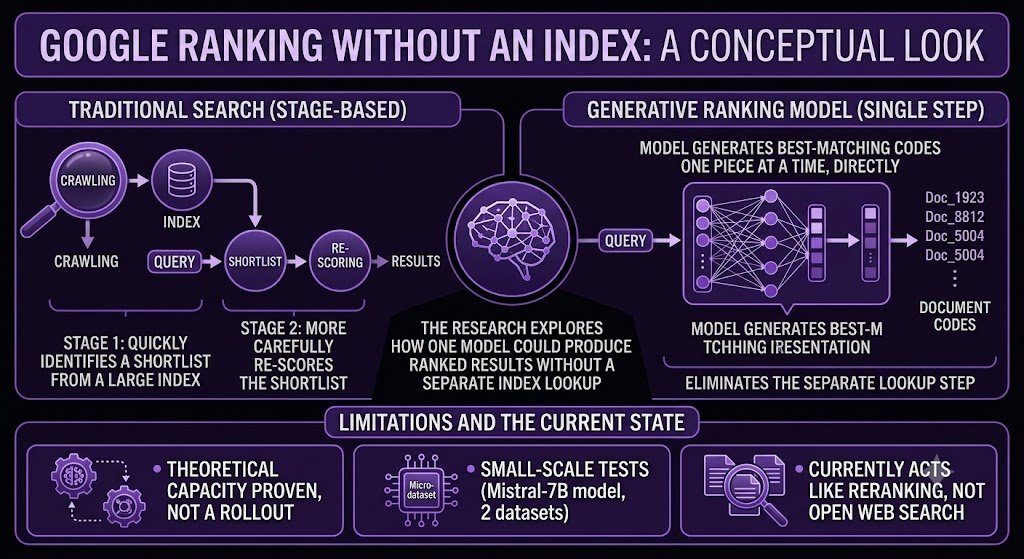
Google ranking without an index may sound confusing, but the basic idea is simple. Right now, search runs in stages. Google crawls pages and stores them in an index. A fast first step pulls a shortlist for your query. A slower, more careful step then re-scores that shortlist.
The new research explores how Google ranking without an index could work through a single generative model. Instead of looking up a page in a separate index, the model produces a short code that represents a document, one piece at a time, much like it writes a sentence. The best-matching codes come out first, without a separate lookup step.
Before anyone panics, here are the limits:
- The paper proves a theoretical capacity. The tests were small: a Mistral-7B model, two small datasets, and 310 examples in the shopping test.
- The model picked from candidates already placed in its prompt. That’s closer to reranking than searching the open web.
- Nobody has swapped a real web index for this. It’s a direction, not a rollout.
Why Google Has Been Heading Here Since 2021
The idea behind Google ranking without an index didn’t come out of nowhere. In 2021, Google researchers explored the idea that search could answer queries using a body of documents it can cite, instead of simply presenting a list of references. In 2022, the Differentiable Search Index showed that a single Transformer model could map a query directly to document identifiers.
Forrester sees the 2026 paper as an important theoretical step in this development. The journey moves from proposal to prototype and then to theoretical proof. However, Google described the earlier work as a research proposal, not a product plan, and that distinction still matters when discussing the future of Google ranking without an index.
What Happens to the Search Results Page
This is where the headline comes from. A generative ranker builds its list through beam search. At each step it keeps only a fixed number of the most likely candidates. Keep ten, and you get ten results. Position eleven isn’t a poor ranking. It was never produced.
So page two stops being a design choice and simply doesn’t exist. Visibility turns into a yes-or-no question: are you in the generated set or not? And from the outside, “ranked low” and “never generated” look exactly the same.
Cost matters here too. Skipping the separate index and per-document scoring makes generated results cheaper to serve, according to Forrester. Cheaper AI https://en.wikipedia.org/wiki/Artificial_intelligence answers weaken one of the reasons to keep the classic list.
Here’s where I land. The ten blue links will matter less as Google leans on direct answers and AI-generated results. I don’t think they disappear, though. People still click when they want to compare options, check a business, or hire someone.
How Ranking Changes: Today vs. the Research
| Today’s pipeline | Generative ranking (research) | |
| Finding pages | Separate index plus retrieval | Model generates document codes |
| Result list | Long list, page two exists | Short list, beam width sets the limit |
| Tracking | Position 1 to 100 | In or out of the generated set |
| New pages | Crawled and added | Must be learned by the model |
| Page problem | Thin or weak content | Near-duplicates fight for one code |
What I’ve Seen With Clients: Traffic Isn’t the Goal
One local service business I worked with had decent traffic but weak enquiries. Rankings weren’t the issue. The page was.
I changed four things:
- I matched the content to what searchers actually wanted.
- I explained the services in plain language.
- I added relevant local keywords.
- I made the call to action easy to spot.
The lesson stuck with me. Traffic is only step one. A page also has to build trust and nudge people to act.
That’s the same shift Google is working toward in the lab. Search is moving toward intent and useful answers, so I now judge every page by one question: does it give people what they came for?
Common Mistakes I See Right Now
Most of these show up again and again:
- Chasing rankings and keywords instead of intent. A page can rank and still fail the visitor.
- Publishing only for traffic. No useful answers, no trust signals, no clear CTA.
- Ignoring the basics. Technical SEO, structured data, and content quality still matter.
- Keeping near-duplicate pages live. Forrester points out that under a generative index, two near-identical pages would compete for the same identifier, and one would lose.
What To Do This Week
You don’t need to rebuild anything because of a research paper. Start small:
- Improve your existing content. Pick your most important pages. Give each one a clear, helpful answer to what customers actually search for.
- Build trust. Check that your business details, services, contact information, and reviews are accurate and consistent everywhere.
- Fix your conversions. Look at every key page. Is the CTA obvious? Can someone enquire in under a minute?
- Start tracking inclusion. Forrester suggests measuring whether you show up at all, not just where you rank. Building a baseline now gives you history later.
Results will vary. A local service business and an online store won’t experience Google ranking without an index in the same way, and the timing of any real-world changes remains unknown.
FAQs
Does Google rank pages without an index today?
No. This is research, not a live system. The tests were small, and Google still uses its normal crawling and indexing.
Is Google ranking without an index the end of the ten blue links?
I don’t think so. They’ll likely matter less as direct answers grow, but people will still click through when they need more than a summary.
Do keywords still matter?
Yes, but not on their own. Keywords help Google understand a page. Intent, quality, and trust decide whether the page earns the visit and the enquiry.
What should a small business do first?
Improve your top pages, keep your business details consistent, and make your CTA obvious. These steps help with today’s search and with whatever comes next.
Final Thoughts
Google ranking without an index is still a research result, and Forrester himself describes his predictions as informed speculation. He also founded a measurement company, so it’s worth keeping his measurement perspective in mind. However, the research into Google ranking without an index raises important questions about the future of search: shorter result lists, more direct answers, and less room for pages that don’t genuinely help users.
Looking for the Best Digital Marketing Expert in Thrissur Amal Anil helps businesses improve their online visibility through SEO, social media marketing, content marketing, Google Ads, and website optimization. With practical, goal-focused strategies, the aim is to attract the right audience, generate quality leads, and support sustainable online