
Table of Contents
- Primary keyword: Google hidden data layer
- Meta description : The Google hidden data layer shapes search rankings beyond keywords. Discover common website issues and learn practical SEO fixes to improve your online visibility.
- URL slug: /google-hidden-data-layer
Two pages on the same site can have nearly identical content and still perform very differently. I first ran into this with a client, and it changed how I audit websites. The difference wasn’t keywords. It was something I now call Google’s hidden data layer.
In this guide, I’ll explain what the hidden data layer is, where most sites go wrong, and the process I use with new clients to close the gap.
Why the Google Hidden Data Layer Matters Beyond Keywords
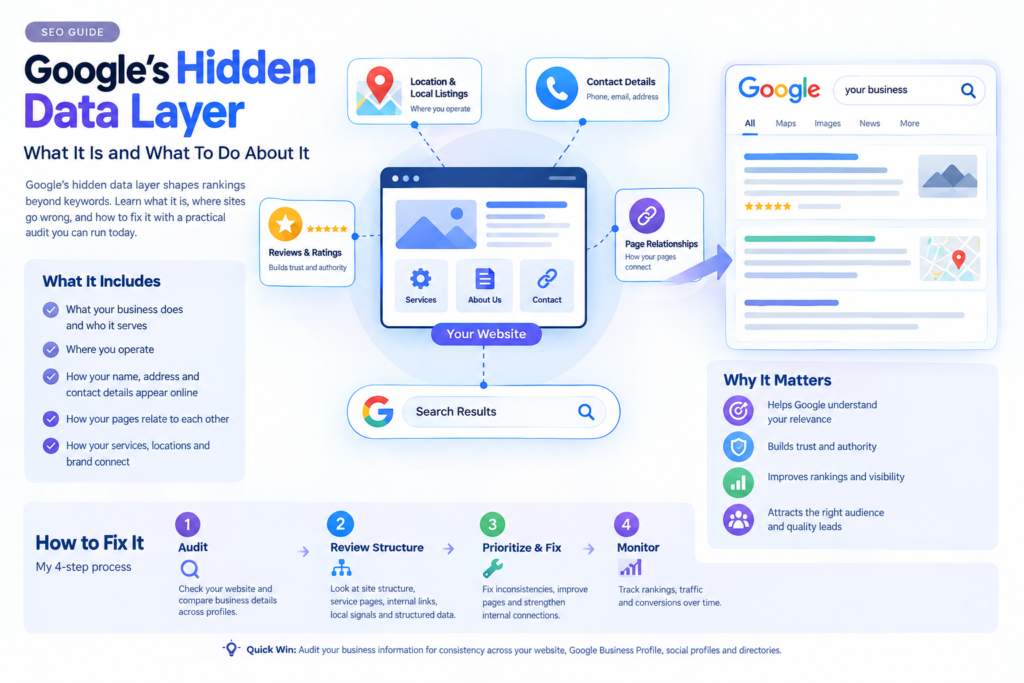
The Google hidden data layer refers to the information Google collects and connects behind the scenes to understand your website and business. Google doesn’t publish it as a single report, and you can’t access it through a dedicated dashboard. Instead, the term describes how I think about the bigger picture of website information, business details, and the connections that help search engines understand your online presence.
It includes things like:
- What your business does and who it serves
- Where you operate
- How your name, address, and contact details appear across the web
- How your pages relate to each other
- How your services, locations, and brand connect
Google uses all of that to decide whether you’re relevant to a search. Your visible page content is only one input.
Why the Google Hidden Data Layer Matters Beyond Keywords
Many SEOs overestimate the value of adding more keywords. I’m one of the people who disagree with that habit.
A page can be fully optimized and still struggle. The Google hidden data layer helps explain why clear business information, relevant context, internal links, and consistent signals matter alongside keyword optimization. Without these elements, search engines may have less context to understand the website and its services.
So I try to build websites that make the topic and the business easy for Google to understand. Keyword placement is still part of SEO, but the Google hidden data layer is another important part to consider..
A real example: one page, plenty of traffic, almost no enquiries
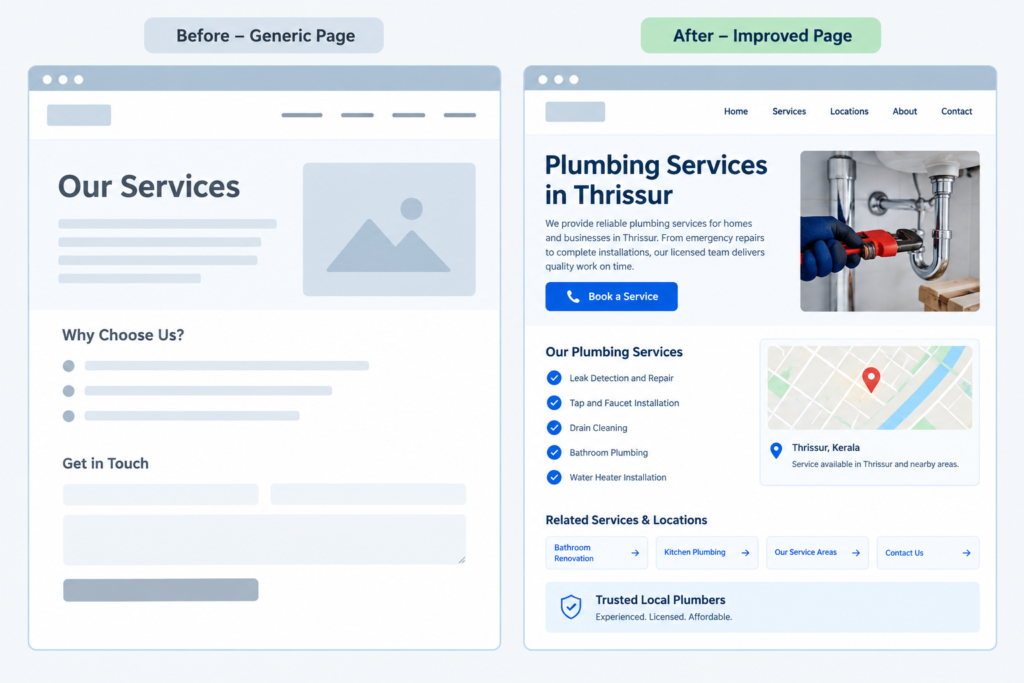
A local service business came to me with a page that had decent traffic but very few enquiries. Similar pages on the same site did better, which made it confusing.
I compared the weak page against stronger competitors. The problem showed up quickly. The page was too generic. It could have described almost any provider in any town.
Here’s what I changed:
- Improved the service information so it said something specific.
- Matched the page to what searchers were actually looking for.
- Added clearer location and business context.
- Strengthened internal links from related pages.
- Made the call to action easier to see.
Organic visibility improved, and the enquiries became more meaningful. I didn’t add a pile of keywords to get there. The page became more useful, more specific, and better connected to the rest of the site. One caveat: this is one client, and results will vary with competition and industry.
The most common mistakes I see
When I audit a site, the same issues keep turning up. Here’s how they compare with what Google needs.
| Common mistake | What Google needs instead |
| Different business names, addresses, or phone numbers across profiles | One consistent set of details everywhere |
| Thin service pages | Specific, useful pages with real detail |
| Weak internal linking | Clear paths between related services and locations |
| Poorly structured information | Pages organized so the topic is obvious |
| Unclear links between services, locations, and brand | Obvious relationships between each of them |
Behind all of these sits one bigger mistake: focusing only on keywords. Google needs consistent information about what a business does, who it serves, and how its pages and entities connect.
My process for fixing the hidden data layer
This is the process I use when a new client signs on. It’s the same four steps every time.
Step 1: Audit
I review the website and compare business information across key online profiles. That means checking the name, location, services, and contact details everywhere they appear.
Step 2: Review structure
Next I look at site structure, service pages, internal links, local signals, and structured data. I also compare the weaker pages with competitors who rank well.
Step 3: Prioritize and fix
I rank the gaps by impact. Then I fix inconsistent information, improve pages, strengthen internal connections, and clarify how services, locations, and the brand relate.
Step 4: Monitor
I track rankings, impressions, traffic, and conversions over time. This is ongoing work, not a one-time fix. Search results move, and so do competitors.
If you want a head start on step 2, read my guide on how to audit your service pages (internal link goes here). For structured data basics, Google Search Central’s introduction to structured data is the most reliable place to begin.
One fix you can make this week
Audit your business information for consistency. It’s the fastest win I know.
Check these places:
- Your website
- Google Business Profile
- Social profiles
- Directories and listings
Compare the name, address, phone number, services, and location details in each. Make them match. Even small differences, like “Street” in one place and “St.” in another, add noise. Inconsistency makes it harder for search engines to work out who you are, what you offer, and where you operate.
When the Google Hidden Data Layer Advice May Not Apply
Every site is different. A brand-new site with almost no content has bigger problems than entity consistency. A national brand with hundreds of locations needs a more technical approach to improve its Google hidden data layer. Fixing the hidden data layer won’t rescue a page that doesn’t answer what people are searching for. Treat this as one important part of a larger SEO strategy.https://en.wikipedia.org/wiki/Search_engine_optimization picture.
FAQs
What Is the Google Hidden Data Layer?
The Google hidden data layer refers to the connected information Google uses to understand your website and business, including your services, locations, contact details, and page relationships. These signals help Google understand your business and evaluate its relevance to search queries.
Is the hidden data layer an official Google term?
No. It’s a way of describing how Google builds an understanding of a business beyond the words on a page. Google doesn’t offer a report for it.
How do I improve my hidden data layer?
Start by making your business details consistent across your website and profiles. Then strengthen internal links, improve thin service pages, and add structured data where it fits.
Can keywords alone fix a page that isn’t ranking?
Rarely. If the page lacks context, connections, or consistent signals, more keywords won’t close the gap.
How long do the results take?
It varies. I monitor rankings, impressions, traffic, and conversions over time, because improvements usually build gradually rather than overnight.
Conclusion
Google’s hidden data layer explains why identical-looking pages perform differently. Your keywords matter, but the clarity and consistency of your business information matter just as much.
Looking for the Best Digital Marketing Expert in Thrissur Amal Anil helps businesses improve their online visibility through SEO, social media marketing, content marketing, Google Ads, and website optimization. With practical, goal-focused strategies, the aim is to attract the right audience, generate quality leads, and support sustainable online growth.