
Table of Contents
Primary keyword : Google query fan-out framework
Meta Description : Google query fan-out framework explained through Google’s R4T-Diffusion research, with practical insights on content strategy and real SEO client data.
URL Slug : /google-query-fan-out-framework
Google Query Fan-Out Framework: What R4T-Diffusion Means for Your SEO Strategy
If you’ve been watching your Search Console reports and noticing impressions from questions you never actually wrote about, you’re not imagining things. Google’s query fan-out framework is the reason, and a new research paper called R4T-Diffusion just gave us a much clearer picture of how it works under the hood.
I’ve seen this pattern show up in client accounts for a while now, well before this paper had a name attached to it. This post breaks down what R4T-Diffusion actually is, what I’ve observed in real campaigns, and what it means for how you plan content going forward.
What Is Google’s Query Fan-Out Framework?
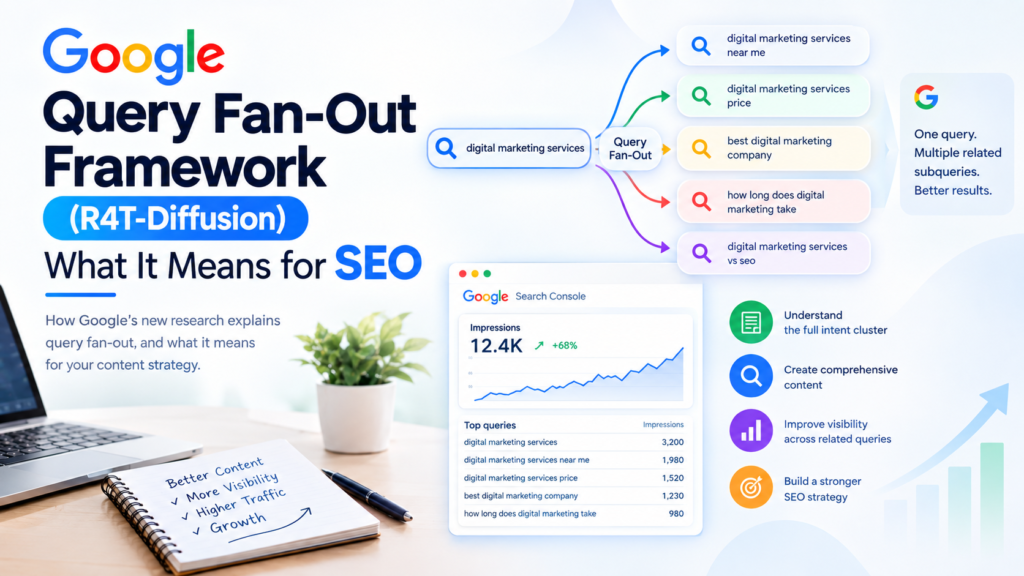
Query fan-out is the process where a search system takes one broad query and generates a set of related subqueries to retrieve a more complete, diverse group of results, rather than chasing a single best match.
Google researchers published a paper describing R4T (Retrieve-for-Train), a method that trains a lightweight diffusion-based retrieval model to handle this fan-out process efficiently. In plain terms: instead of running an expensive, RL-tuned language model at the moment someone searches, Google can use that model once during training, then hand the job off to a much faster diffusion retriever at query time.
Worth noting up front: the published research was tested on fashion and music recommendation datasets, not confirmed as a live web search ranking system. That said, the underlying concept — generating diverse subqueries to cover a broad intent — lines up closely with what SEOs have already been observing in AI Overviews and AI Mode results.
Why This Matters for Your Content Strategy
Here’s the practical shift: if search systems are increasingly built to fan a single query out into a cluster of related ones, then optimizing for one exact-match keyword is a shrinking strategy. Your content needs to hold up across the whole cluster of questions a searcher — or the AI system reformulating on their behalf — might ask.
A Real Example From Client Data
I manage a local SEO client whose page targets digital marketing services. Over time, that page started showing up in Search Console for roughly 20 to 30 related queries and question variations that were never specifically targeted in the content. Things like pricing questions, comparison questions, and “how long does it take” type queries.
That was my first real signal that something like fan-out retrieval was already influencing visibility, months before this research made it explicit.
What Changed in How I Write Content
The main keyword still has a place. I make sure it shows up, just where it reads naturally. But it’s no longer the center of the page. What I care about now is whether the content covers the different things a searcher wants to know, and whether an AI retrieval system could pull a useful answer from it. That’s the practical lesson I took from watching the Google query fan-out framework play out on real client sites. One page can end up ranking for dozens of related queries when it covers the whole topic well.
A Simple Process for Covering Fan-Out Topics
You don’t need to guess at what subqueries might get generated. Here’s the process I use with clients:
- Start with Search Console. Look at the queries a page is already ranking for, especially ones you didn’t deliberately target.
- Check “People Also Ask” and related searches. These are Google’s own signals for adjacent intent.
- Review competitor pages ranking for your primary keyword to spot gaps.
- Group everything by search intent — informational, comparison, transactional — rather than by keyword.
- Write sections that answer each intent cluster naturally, instead of forcing every question into a separate H2.
| Old Approach | Fan-Out-Aware Approach |
| One page, one exact keyword, repeated | One page, one topic, multiple related intents covered |
| Keyword density as the main metric | Topical completeness and intent coverage as the main metric |
| Reactive: wait for rankings to move | Proactive: map the query cluster before writing |
| Content written for the SERP | Content written for the searcher and the retrieval system |
Should You Be Worried About R4T-Diffusion?
No. You don’t need to panic or rebuild your site overnight.
What I do see a lot is marketers reacting to the trend itself. They collect every related keyword they can find and cram it into a page, when the real job is making that page more useful to the person reading it.
The Google query fan-out framework is built to favor content that covers a topic properly and is organized so it’s easy to follow. Nothing about that is new. It’s the same SEO fundamentals, just run through a smarter retrieval layer. Whatever shape the Google query fan-out framework takes once it’s live in search, pages that answer a topic thoroughly, and the follow-up questions around it, will keep having the edge.
Frequently Asked Questions
Is R4T-Diffusion a confirmed Google Search ranking feature?
No. It’s a published Google Research paper on retrieval methodology, tested on fashion https://en.wikipedia.org/wiki/Fashion and music datasets. It hasn’t been confirmed as a deployed web search ranking system, though it reflects the direction Google’s retrieval research is heading.
Does this mean keyword optimization is dead?
No. Your primary keyword still belongs in your title, H1, and early content. What’s changed is that it can no longer be the only thing you optimize for — surrounding intent matters just as much.
How do I know if fan-out is already affecting my pages?
Check Search Console for queries you’re ranking for that you never explicitly targeted. If you see clusters of related questions showing impressions, that’s a strong signal.
Key Takeaways
- Query fan-out means one search can generate multiple related subqueries behind the scenes.
- R4T-Diffusion is Google’s published method for doing this efficiently, though not yet confirmed as live in Search.
- Real Search Console data already shows fan-out-like behavior affecting visibility.
- The fix isn’t more keywords — it’s mapping and covering the full cluster of intent around a topic.
As a best digital marketing expert in Thrissur, I help businesses improve their online visibility through SEO, social media marketing, content strategy, and website optimization. My goal is to create practical, result-focused digital marketing strategies that help businesses reach the right audience and grow online.