
Table of Contents
Primary keyword: Google’s hidden data layer
Meta description : Google’s hidden data layer shapes how your site ranks. Learn what it is, the common mistakes that weaken it, and a simple process to fix it this week.
URL slug: googles-hidden-data-layer
Two pages on the same website can target similar searches, carry similar content, and still perform very differently. I’ve seen this with clients more than once. When it happens, the copy is rarely the problem. The cause is usually Google’s hidden data layer.
In this guide, I’ll explain what Google’s hidden data layer is, which mistakes weaken it, and the process I use to fix it for clients.
What Is Google’s Hidden Data Layer?
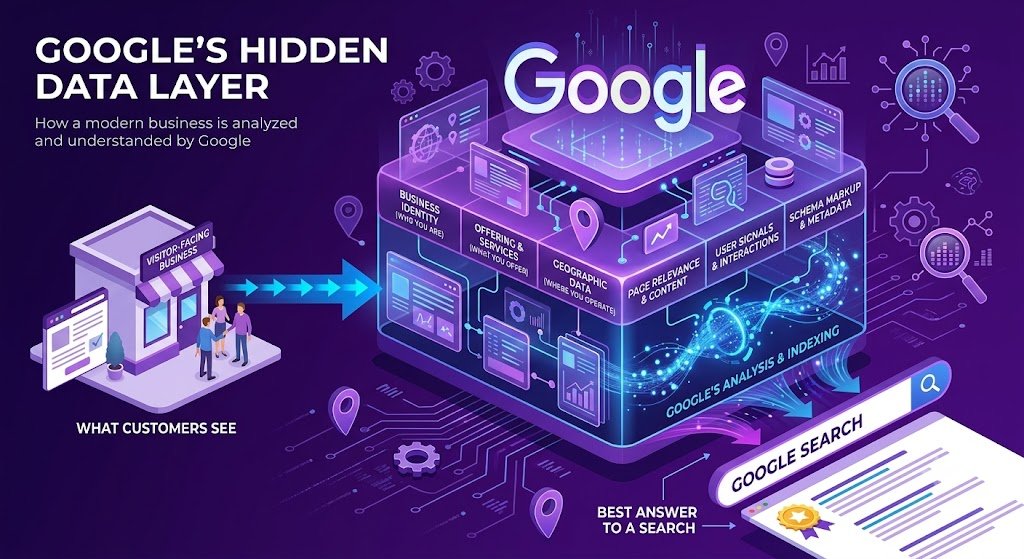
First, a quick honesty check. “Hidden data layer” is not an official Google term. It’s my shorthand for everything Google collects and connects behind the visible page to understand a business.
Visitors never see most of it. Google does. It uses this information to work out who you are, what you offer, where you operate, and which of your pages best answers a search.
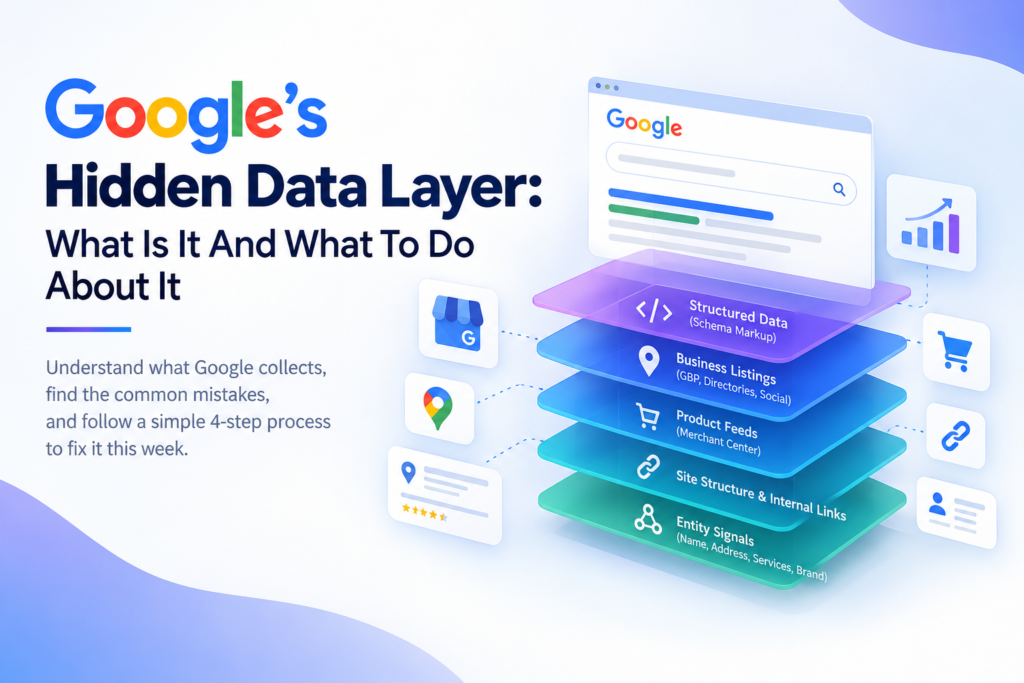
What Makes Up the Layer
- Structured data (schema markup) on your pages
- Business listings, including your Google Business Profile, directories, and social profiles
- Product feeds, such as a Merchant Center feed for ecommerce stores
- Site structure and internal links that show how your pages relate
- Entity signals: your business name, address, services, and brand details across the web
Google’s own documentation explains that structured data helps Google understand page content and can make a page eligible for richer search features. It doesn’t guarantee a ranking, though, and I’d be wary of anyone who says it does.
Product data is a good example of how seriously Google takes this layer. Search Engine Journal reported that Google is working to bring schema.org markup and Merchant Center feed data closer together, so product details stay consistent across shopping surfaces. The direction is clear. Google wants clean, matching data from every source.
Why It Matters More Than Another Keyword
Here’s a real situation. A local service business came to me with one service page that earned some traffic but brought in very few enquiries. Similar pages on competing sites did far better.
I compared the weak page against the stronger competitors. The problem was obvious once I saw them side by side: my client’s page was too generic.
So I fixed the things that sit underneath the keywords:
- I improved the service information so it said something specific.
- I matched the content more closely to what searchers wanted.
- I added clearer location and business context.
- I strengthened internal links pointing to the page.
- I made the call to action easier to spot.
The page became more relevant to the searches it targeted. Organic visibility improved, and the enquiries that arrived were more meaningful.
I should be fair about the limits. I made several changes at once, so I can’t tell you which one did the heavy lifting. Results also vary by industry, competition, and how often Google https://en.wikipedia.org/wiki/Google crawls your site. Still, the lesson held: closing the gap wasn’t about adding keywords. It was about making the page more useful, more specific, and better connected to the rest of the website.
Common Mistakes That Weaken Google’s Hidden Data Layer
Most businesses don’t have a content problem. They have a clarity problem. These are the mistakes I run into most often.
| Mistake | What it looks like | Why it hurts |
| Inconsistent business details | Different names, addresses, or phone numbers across profiles | Google gets conflicting signals about who you are |
| Thin service pages | A few generic lines per service | Nothing sets you apart from competitors |
| Weak internal linking | Important pages are hard to reach | Google can’t see which pages matter most |
| Unclear relationships | Services, locations, and brand aren’t tied together | Google struggles to connect the dots |
| Keyword-only thinking | Pages tuned for phrases, not for people or context | Optimized pages can still underperform |
That last one deserves its own mention. A page can be perfectly optimized for a keyword and still struggle if the wider site has missing context or mixed signals.
How to Fix Google’s Hidden Data Layer: My 4-Step Process
I always approach newly contacted clients the same way. There are only 4 necessary steps in this relatively uncomplicated process, which have proven themselves to be efficient through practice.
1. Auditing the business information
This first step is all about checking what information about the client’s business is available on the web and how it compares to the information on their site. It is vital to standardize all the data on all platforms, both local and international, including the basic information like address, services offered, and contacts.
2. Reviewing the website structure
The proper structure of the website is another important point that I go over when addressing Google’s hidden layer. During the second step of my process, I analyze the organization’s CMS, the main service pages, internal linking, local signals, and structured data. I also compare the client’s underperforming pages to those of their stronger competitors, looking for inconsistencies and areas of improvement.
3. Prioritizing and implementing changes
The third step is all about prioritizing the issues found and working on standardizing the data. After that, I move on to improving the relevant pages, internal linking, and other elements I have identified as a problem during the auditing stage.
4. Tracking improvements
The final step is monitoring the changes and the improvements in the search results. As long as Google and the competitors do not stand still, a company’s position in search results can only remain the same or change. That is why I believe this step is continuous and should never have an end.
One Fix to Make This Week
If you only have time for one thing, audit your business information for consistency.
Open your website, Google Business Profile, social profiles, and the main directories where you’re listed. Then check that these match everywhere:
- Business name
- Address
- Phone number
- Services offered
- Location and service-area details
It’s a small job, but it gives search engines a cleaner picture of who you are, what you offer, and where you work. That’s a solid base for your local SEO and your wider visibility.
My Take: Stop Chasing Keyword Counts
Many SEOs still overrate keyword repetition. I’d rather build a site that makes the business and the topic easy for Google to understand.
Keywords still matter, of course. They just can’t carry a page on their own when the information around them is thin or contradictory.
FAQs
Is Google’s hidden data layer an official Google term?
No, it’s not. This term refers to the combination of structured data markup, listings, feeds, links, and entity signals that Google uses to understand the content of a business.
Does using structured data markup guarantee higher ranking?
No, it does not. Structured data markup helps Google better understand the content on your page, and therefore, you may see more prominent displays of your data (rich snippets), but there are many other ranking factors.
Is there a period during which the changes will begin to show results?
It’s impossible to say how long it will take for changes to show results. It depends on how often Google is indexing your content, how competitive your niche is, and how much optimization was needed.
How often should I be auditing the company’s information?
I would suggest auditing it every time you update any information, including services, branches, addresses, and others. It should also be part of your regular SEO auditing process.
Should I focus on optimizing the content or fixing data issues first?
It’s a great idea to prioritize issues connected to entities and consistency first and then move to optimizing thin content, siloed pages, or internal linking structures. The latter usually yields lower risk and a solid ROI.
Conclusion
Google’s hidden data layer is not a Google™ term. It refers to the complete data set about the company in Google’s possession. Most of it comes from sources external to the business’s website.
As a best digital marketing expert in Thrissur, I help businesses improve their online visibility through SEO, social media marketing, content strategy, and website optimization. My goal is to create practical, result-focused digital marketing strategies that help businesses reach the right audience and grow online.