
Table of Contents
Primary keyword: content marketing strategy.
Meta Description: Learn a practical content marketing strategy from real client work, including a 5-step framework, common mistakes, and proven ways to drive results.
URL Slug : /content-marketing-strategy
Content Marketing Strategy: What Actually Works (From Real Client Work)
If you’ve published post after post and still aren’t seeing traffic move or leads come in, you’re not alone. After years of building a content marketing strategy for clients as a freelance digital marketer, I’ve come to a simple conclusion: the problem is almost never effort. It’s direction.
Most businesses approach content marketing as a numbers game — publish more, post more often, and hope something eventually lands. But the businesses that actually see growth are the ones treating their content marketing strategy as a system built around real search intent and real business goals.
A solid content marketing strategy isn’t about churning out more articles — that part trips a lot of people up. It’s about knowing what your audience actually searches for, what they need when they get there, and making sure the content you create actually ties back to something the business cares about. So here’s what I’ve picked up from doing this work myself: a case study, a framework you can follow step by step, and a few mistakes I keep running into over and over.
Why Content Marketing Strategy Efforts Fall Flat
The mistake I run into most often is businesses publishing content just to look active. They keep to a schedule — blog posts, social updates — without stopping to ask what their audience is actually searching for, where those people are in the buying journey, or how any of it ties back to revenue.
A strong content marketing strategy focuses on relevance rather than simply publishing more frequently. Every piece of content should have a purpose, whether that’s attracting search traffic, answering customer questions, building trust, or generating leads.
But consistency without relevance just produces more content nobody needed. I’d rather see a business publish four sharp, useful articles a month than twelve generic ones — because search engines https://en.wikipedia.org/wiki/List_of_search_engines and readers both reward usefulness over frequency.
I’d rather see a business publish four sharp, useful articles a month than twelve generic ones — because search engines and readers both reward content that genuinely answers questions and solves problems.
A Real Content Marketing Strategy Example: Turning Traffic Into Leads
One client I worked with — a small business — had a website that got some organic traffic but almost no enquiries from it. Rather than adding more articles to the pile, I rebuilt the strategy underneath it:
- Researched relevant keywords and the actual search intent behind them
- Built new content around topics customers were genuinely searching for
- Optimized existing pages instead of abandoning them
- Strengthened internal linking between blog content and service pages
- Improved on-page SEO across the site
Traffic became more relevant, not just larger — and the content started supporting enquiries and leads instead of just generating pageviews. The lesson that stuck with me: content performs best when every article has a clear search intent and a clear link to a business goal.
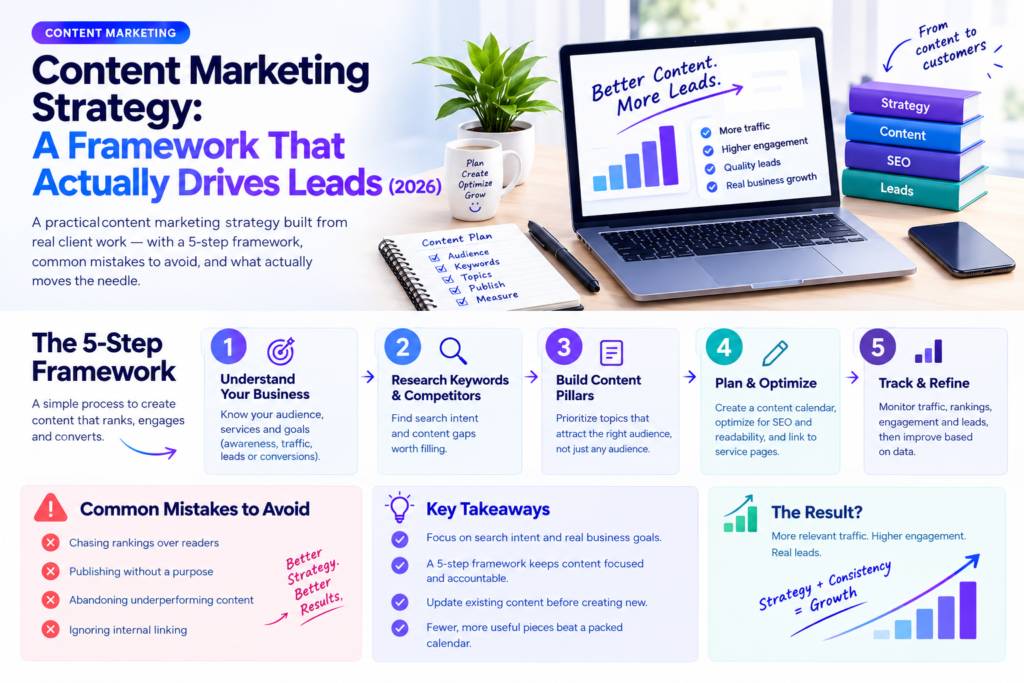
A 5-Step Content Marketing Framework
This is the process I run for nearly every new client, in this order:
- Understand the business. Target audience, products or services, and the actual goals behind the content — awareness, traffic, leads, or conversions.
- Research competitors and keywords. Identify search intent and content gaps competitors haven’t filled well.
- Build content pillars. Prioritize topics by their potential to attract the right audience, not just any audience.
- Plan and optimize. Create a content calendar, and optimize each piece for SEO, readability, and intent — while linking it naturally to services or conversion paths.
- Track and refine. Monitor organic traffic, rankings, engagement, and leads, then adjust the strategy based on what the data shows.
| Step | Focus | Goal |
| 1. Discovery | Business & audience | Align content with real goals |
| 2. Research | Keywords & competitors | Find intent gaps worth filling |
| 3. Planning | Content pillars | Prioritize high-potential topics |
| 4. Execution | Calendar & optimization | Publish content that ranks and converts |
| 5. Measurement | Metrics & iteration | Improve based on real performance |
Common Content Marketing Mistakes to Avoid
- Chasing rankings over readers. SEO matters, but content should answer a real question first. Traffic without relevance doesn’t convert.
- Publishing without a purpose. Every piece should map to a stage of the buyer journey — awareness, consideration, or decision.
- Abandoning underperforming content. Instead of writing something new, updating and repurposing an existing page is often the faster win.
- Ignoring internal linking. Blog content that never points to service pages leaves leads on the table.
An Approach That Goes Against Common Thinking
Most advice says “publish more.” In my experience, it’s the opposite: a handful of genuinely strong pieces will usually beat a packed, unfocused content calendar. And before jumping to create something new, it’s worth checking what you already have — updating and strengthening existing pages often pays off more than starting over.
None of this means SEO takes a back seat. It just means SEO and reader value have to work together, not pull in different directions.
Frequently Asked Questions
How long before a content marketing strategy starts showing results?
Usually three to six months before you see a real shift in organic traffic — though that timeline moves depending on your industry, how competitive it is, and how much optimization work has already gone into your existing content.
Blog content or social media — where should I start?
Go where your audience already is. For most B2B brands, that means search-driven blog content; consumer brands often see social media carry more weight early on.
Does repurposing content work as well as creating something new?
In the short term, often better — you’re building on content that already has authority and search visibility instead of starting from square one.
Key Takeaways
Content marketing succeeds when it’s shaped around search intent and real business goals, not how often you publish.
A simple five-step framework (discovery, research, planning, execution, measurement) keeps content focused and accountable.
- Auditing and improving existing content is often a faster win than creating new content.
- Fewer, more useful pieces tend to outperform frequent, generic ones.
As a best digital marketing expert in Thrissur, I help businesses improve their online visibility through SEO, social media marketing, content strategy, and website optimization. My goal is to create practical, result-focused digital marketing strategies that help businesses reach the right audience and grow online.