
Table of Contents
- Primary keyword: full-funnel ecommerce account structure
- Meta description : Learn how to set up a full-funnel ecommerce account structure for Q4, with budget splits, campaign stages, and mistakes to avoid before the Black Friday rush.
- URL slug: /full-funnel-ecommerce-account-structure-q4
Most ecommerce ad accounts that struggle during Q4 do so not because their creatives were bad, but because the ad account structure couldn’t keep up with the shifting funnel of the shoppers. In October, shoppers are browsing and comparing, while in Black Friday they are buying. A full-funnel ecommerce account structure will let you target both types of audiences without having to resort to rebuilding your ad campaigns halfway through the year.
One thing to note before moving on to the splits: the splits listed below are just a starting point, as audience sizes and margins may vary drastically between different niches. Use the splits as a general guide and not an indication of performance.
Why Q4 Needs A Full-Funnel Approach
Many stores wait until Black Friday and push everything into retargeting. It feels logical, since those shoppers are closest to buying.
The problem is that retargeting only works on people who already know you. If you haven’t spent October bringing new visitors to your site, your retargeting pool will be small by the time you need it. You end up paying more to chase the same few people.
A Q4 ecommerce advertising strategy has to build demand early and collect it later. That’s the whole idea behind a funnel. A full-funnel ecommerce account structure helps businesses manage this process effectively. Setting up a full-funnel ecommerce account structure before the holiday season helps prepare campaigns for changing shopper behavior.
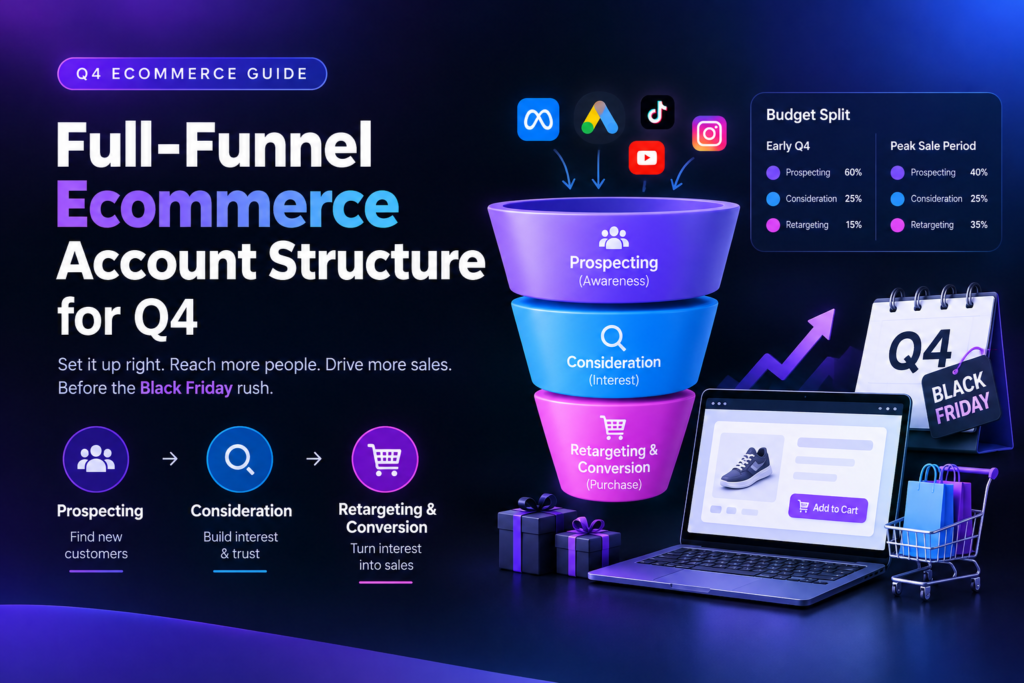
The Three Stages Of A Full-Funnel Ecommerce Account Structure
I like to keep this simple. Three stages is enough for most small and mid-sized stores, and it’s easy to read when you’re checking performance in the middle of a sale.
1. Prospecting
These campaigns reach people who haven’t met your brand yet. Think broad audiences, interest-based targeting, lookalikes of past buyers, and product discovery placements.
The goal here isn’t immediate sales. It’s reaching new people cheaply and feeding the stages below. Judge these campaigns by reach, traffic quality, and add-to-cart rate, not just last-click revenue.
2. Consideration
This middle stage targets people who have shown some interest. They watched a video, engaged with your social posts, or viewed a product page but didn’t add anything to the cart.
Many accounts skip this stage, and that’s a mistake. It’s where you answer questions, show reviews, and highlight bundles or gift ideas. Holiday shoppers often need a nudge here.
3. Retargeting And Conversion
This is the high-intent group: site visitors, cart abandoners, checkout abandoners, and past customers. Offers, deadlines, free-shipping cutoffs, and low-stock messages work well here.
Keep this stage separate from the others. When you can see prospecting vs retargeting campaigns side by side, it’s much easier to tell where your money is actually working. A full-funnel ecommerce account structure helps you manage these audiences and optimize your Q4 campaigns more effectively.
How To Split Your Q4 Holiday Ad Budget
Here’s the split I’d use as a starting point for a mid-sized ecommerce brand. It’s a framework, not a rule.
| Stage | Early Q4 | Peak sale period |
| Prospecting | 60% | 40% |
| Consideration | 25% | 25% |
| Retargeting | 15% | 35% |
The logic is straightforward. Early on, you’re building an audience, so most of your Q4 holiday ad budget goes to reaching new people. As the sale gets close, your retargeting pools are bigger and purchase intent is higher, so more money https://en.wikipedia.org/wiki/Money moves there.
Notice that prospecting never drops to zero. Even at the peak, you still want fresh people entering the funnel.
Three things should drive any shift in the split:
- Performance: which stage is producing profitable sales
- Audience size: a small retargeting pool can’t absorb a big budget
- Purchase intent: rising add-to-cart and checkout activity is your signal to lean toward conversion
I haven’t tied these exact percentages to a specific client result, and you shouldn’t expect them to work identically for you. Compare ROAS, cost per acquisition, and total sales before and after each change. That comparison tells you whether the shift helped. A full-funnel ecommerce account structure makes it easier to evaluate these metrics across campaign stages and adjust your budget based on actual performance.
The Biggest Q4 Mistakes To Avoid
Starting too late
Waiting for Black Friday is the most common mistake. By then, ad costs are higher and you’ve got no warm audience built up. Start building demand weeks earlier.
Chasing conversions only
An account that is all retargeting looks efficient for a while. Then the audience runs dry, and sales flatten right when you need them most.
Raising spend without checking the basics
More budget makes every problem more expensive. Before you scale, check these:
- Products are in stock
- Landing pages load fast on mobile
- Offers are clear, with pricing that matches the ad
- Checkout works without friction
- Conversion tracking records purchases and revenue correctly
If tracking is broken, you’ll make budget decisions on bad numbers. Google’s guide on how conversion tracking works is a good place to confirm your setup. A full-funnel ecommerce account structure also helps you monitor performance across campaign stages and make more informed budget decisions.
What To Set Up First If You Only Have A Few Weeks
Short on time and budget? Do these three things, in this order:
- Set up conversion tracking. Track purchases, revenue, and ROAS before you spend anything. Every other decision depends on it.
- Build a simple full-funnel campaign structure. Even two campaigns help: one for prospecting and one for retargeting. Add the middle stage once you have the traffic.
- Prepare your pages and offers. Test mobile speed, run a real checkout, confirm stock, and make sure sale prices show correctly.
Then start small. Put more money behind what produces profitable sales, and resist spreading a limited budget across too many campaigns.
How To Tell Whether Your Changes Worked
Don’t judge by feel. Pick a baseline before you move any budget, then compare:
- ROAS and cost per acquisition for each stage
- Total sales across the account, not just platform-reported numbers
- Add-to-cart and checkout rates
- Size of your retargeting audiences over time
Results also depend on your market. A niche store with little competition may behave very differently from a crowded category, so give each change enough time and data before reacting. A full-funnel ecommerce account structure makes it easier to track these metrics across each stage and make informed budget decisions.
FAQs
What is a full-funnel ecommerce account structure?
It’s a way of organizing your ad campaigns by shopper stage: awareness, consideration, and conversion. Each stage has its own audience, message, and budget, so you can see what’s working at every point.
How much of my budget should go to retargeting in Q4?
There’s no universal number. As a starting point, 15% early in Q4 and around 35% at the peak is reasonable for many mid-sized stores. Adjust it using your audience size and conversion data. A full-funnel ecommerce account structure helps you allocate your budget across campaign stages based on performance and audience size.
When should I start Q4 campaigns?
As early as your budget allows. Building awareness weeks before Black Friday gives you a bigger audience to retarget when intent peaks.
Can small stores use this structure?
Yes. Start with two campaigns, prospecting and retargeting, and add a consideration stage when you have enough traffic.
Conclusion
The efficient account structure for full-funnel ecommerce organizations rests on three pillars: demand generation, separation of all stages, and budget shifting depending on analytics. The initial steps to take are research, installation, and moderation in accordance with the provided percentages. Remember that a full-funnel ecommerce account structure should be established prior to the holiday season in order to obtain the most beneficial outcomes.
Looking for the Best Digital Marketing Expert in Thrissur Amal Anil helps businesses improve their online visibility through SEO, social media marketing, content marketing, Google Ads, and website optimization. With practical, goal-focused strategies, the aim is to attract the right audience, generate quality leads, and support sustainable online