Table of Contents
SEO Title: Organic Rankings vs Product Grids: The New Ecommerce Divide
Meta Description: Organic rankings vs product grids are two separate games. Learn why strong SEO doesn’t guarantee product visibility in ecommerce and how to close the gap fast.
URL Slug: /organic-rankings-vs-product-grids
Primary Keyword: organic rankings vs product grids
You check Google and your category page is sitting in the top three. Nice. Then you click over to the shopping results and your products aren’t there. Not on page one, not anywhere you can find.
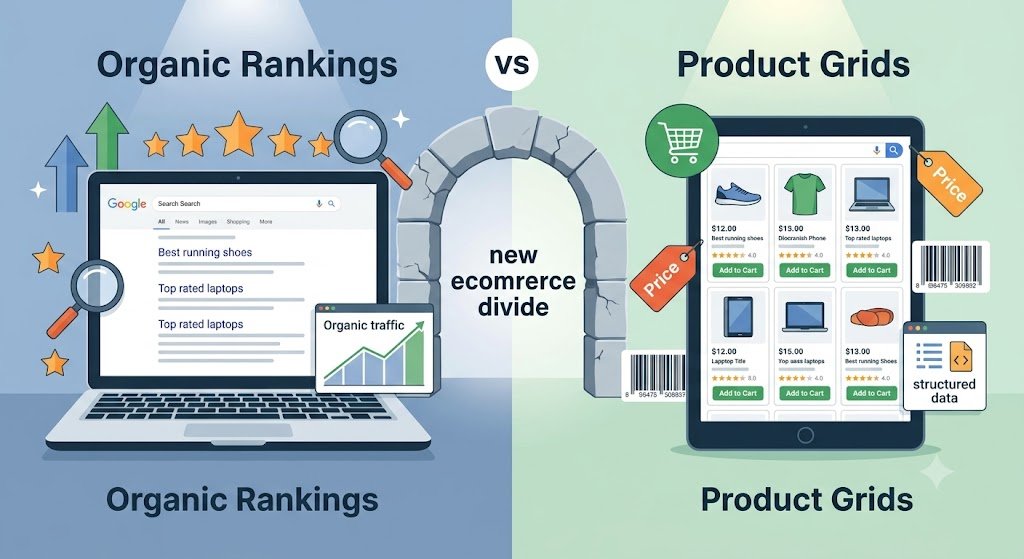
It’s a strange feeling, and I see it with ecommerce clients more often than you’d expect. The reason is pretty simple. Organic rankings vs product grids is not one contest with two views of the same result. They’re two separate systems, and winning at one says almost nothing about the other.
So let’s go through how they differ, why the gap matters, and what I look at first when a store ranks fine but its products stay hidden.
Show Image
What’s Actually Different About Organic Rankings vs Product Grids?
Organic rankings are about pages. Google reads your content, weighs your links, looks at how useful the page is, and decides where it belongs.
Product grids work on individual products. They’re built mostly from structured data: your feed, your markup, your price, whether the item is in stock, what the reviews say. The page still matters, but the data does most of the talking.
Side by side, it looks like this:
| Organic rankings | Product grids | |
| What gets ranked | A page | A single product |
| Main input | Content, links, relevance | Product feed and structured data |
| What wins | Quality, authority, site experience | Complete data, fair price, stock, reviews |
| Where to look | Google Search Console | Google Merchant Center |
| Usual fix | Content, internal links, technical SEO | Titles, attributes, GTINs, variants |
Once you see it laid out, the gap makes sense. Different inputs, different results.
Why Organic Rankings vs Product Grids Don’t Always Match
Here’s a case from my own work. A client of mine runs a small fashion and lifestyle store. Their category pages brought in steady organic traffic, so from an SEO point of view, things looked healthy.
The products themselves, though? Barely visible in Google’s product results.
I went looking for the cause, and it wasn’t content or backlinks. It was the product data. The gap between organic rankings vs product grids became clear once I checked the feed. Titles were far too generic. Important attributes were missing. A few variants were half filled in. And the feed didn’t always agree with what was on the website.
So we fixed it. Cleaner feed, clearer titles, the missing attributes added, product details matched to the site. Product visibility improved noticeably after that. We never changed the broader SEO strategy, and that’s the part I keep coming back to.
One honest caveat: this won’t rescue every store. If your prices sit well above competitors, or nobody wants the product, tidy data won’t change that. But it’s the cheapest thing to rule out, so I always start there.
How I Check If Product Data Is the Problem
With a new client, I do roughly the same thing every time.
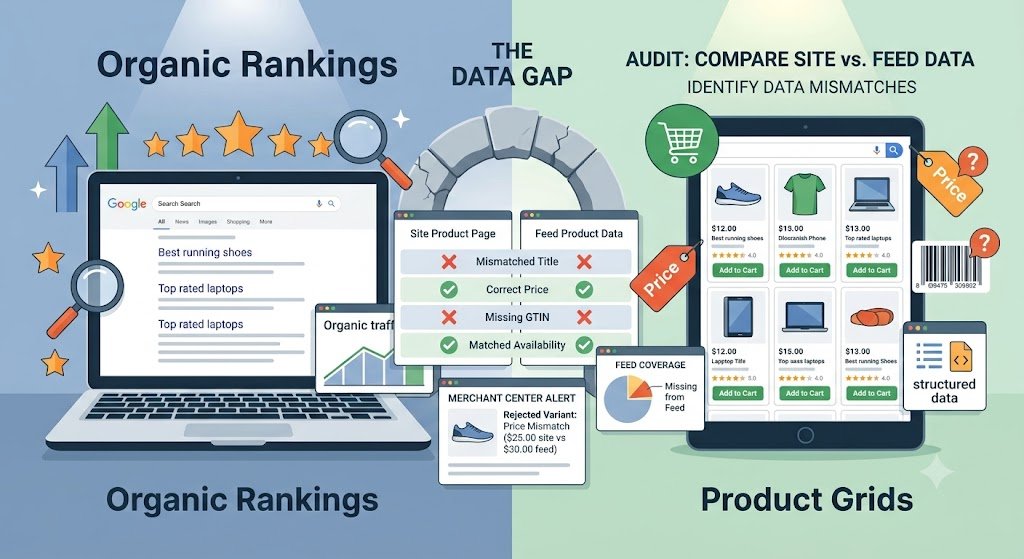
First, I put the product pages next to the product feed. Titles, prices, availability, images, variants. Do they match?
Then I look for the obvious stuff: missing data, rejected products, prices that don’t agree, duplicate variants, and products that are live on the site but missing from the feed. You’d be surprised how often that last one turns up.
Next I pick a few products that get organic traffic and a few that actually appear in product grids, and I compare them. What do the visible ones have that the others don’t?
Finally, if the data looks clean, I stop blaming it. At that point, organic rankings vs product grids may be affected by competition, pricing, demand, or the page itself. People skip this step and end up “fixing” data that was never broken..
The fields I check first
- Product titles
- Price and availability
- Images
- Variants, like size and color
- Brand
- GTINs and other identifiers
Google has its own product data specification. Keep it open in a tab while you audit.
Mistakes I See When SEO and Product Listings Get Lumped Together
Almost all of them start with one assumption: the page ranks, so the product must be fine.
Some of the usual suspects. Using the same generic title everywhere, even though a title that works on a page often flops in product search. Obsessing over keywords while ignoring attributes, GTINs, variants, and stock status. Never opening Merchant Center at all, so product issues pile up quietly while the team writes yet another blog post.
Then there’s the traffic myth. More organic visits do not automatically earn more grid placements. And plenty of people only watch rankings and clicks, when product impressions, clicks, and conversions deserve their own reporting.
My view is that these are connected but separate channels. Your website has to work for people. Your product data has to be accurate and structured enough for shopping systems to read. Both jobs matter, and neither one covers for the other.
If You Can Only Fix One Thing This Week
Audit your product data. Go through titles, descriptions, images, prices, availability, variants, brand, and identifiers, and fix whatever’s missing or doesn’t match.
Why this first? Because a well-optimized page can still struggle in product grids if Google is getting incomplete or wrong data. And it’s a lot less work than tearing up your SEO plan, since it targets the information Google actually uses to match your products to searches.
Where Ecommerce Visibility Is Heading
My opinion is that we are shifting from the first step (ranking a page) to the second (interpretation in different systems) and, more specifically, the coexistence of multiple systems in which search results, shopping grids, AI assistants, marketplaces, and social networks https://en.wikipedia.org/wiki/Social_network are key players. Any of these can influence the discovery of products, so we must optimize for all of them.
Although no one knows the precise weight of each element and those who say so are bound to be wrong, the tendency is clear enough to be decisive.
Titles, descriptions, attributes, prices, and availability must be accurate in all channels. We must accumulate reputational elements such as user reviews and take advantage of Product structured data. And we must remember that the conquest of relevance in these systems will be based to a large extent on brand strength, not simply on keywords.
Frequently Asked Questions
Why do my pages rank but my products don’t show in Google’s product results?
Mostly because the two systems run on different inputs. Rankings come from page signals. Product grids lean on feed quality, price, availability, and reviews. Check your feed for missing or mismatched data first.
Do I need a separate strategy for organic search and product listings?
You need one plan with two sets of checks. Track rankings and traffic in one place, and product impressions, clicks, and conversions in another.
Will better product data guarantee more visibility?
No. It clears out a common blocker, but price, competition, and demand still count.
What should I look at first in Merchant Center?
Rejected or limited products. After that, compare a handful of products against their live pages and look for price, stock, and variant mismatches.
Conclusion
Organic rankings vs product grids is the new battleground in ecommerce, and many are on the wrong side of the fence without realizing it. A page may rank well, but the products it features remain hidden.
The most important takeaway from this post is to treat them as two channels, audit your feed against your live product pages, and fix titles, attributes, GTINs, and variants before anything else. Track product performance separately from rankings. And before you blame the data, rule out price, competition, and demand.
As a best digital marketing expert in Thrissur, I help businesses improve their online visibility through SEO, social media marketing, content strategy, and website optimization. My goal is to create practical, result-focused digital marketing strategies that help businesses reach the right audience and grow online.