Table of Contents
Meta Description : Amazon Google Shopping ads have been gone in the US for a year. Here’s what changed for CPCs, rivals, and ROAS, and what smaller retailers should do now.
URL Slug: /amazon-google-shopping-exit-one-year-later
Primary keyword: Amazon Google Shopping
Secondary keywords: Amazon left Google Shopping, Google Shopping CPC, Google Shopping ROAS, Google Shopping ads strategy, Google Shopping competition, Amazon Google Shopping ads pause, Google Shopping impression share
Amazon Google Shopping: What Changed After Amazon Left the US Auction
A year ago, Amazon Google Shopping ads disappeared from US https://en.wikipedia.org/wiki/United_States results almost overnight. On July 21, 2025, Amazon’s impression share against the median competing retailer sat at 60%. Two days later, it was zero. It hasn’t come back.
Most advertisers expected a windfall: cheaper clicks, more impressions, easy wins. Some got a little of that. Many didn’t.
Here’s what the data shows, where the early predictions missed, and what I’d do with a Shopping account right now.
What Actually Happened When Amazon Left Google Shopping
The Amazon Google Shopping exit wasn’t limited to the US. Amazon dropped out of Google Shopping auctions in the UK, Germany, and more than a dozen other markets during the same period. Within a month, Amazon had returned in the international markets tracked by Smarter Ecommerce, except the United States.
In the US, Amazon Google Shopping impression share remained at 0% in Tinuiti’s Q2 2026 benchmark. The data covers the 2025 holiday season and Prime Day 2026. Amazon continued running Google Search ads and Microsoft Shopping ads during this period, which suggests the Amazon Google Shopping pause was specific to Google Shopping rather than a complete retreat from paid search.
The Amazon Google Shopping change also gave other retailers more opportunities to compete for Shopping impressions. However, the available data shows that those opportunities were distributed across several competitors rather than creating an automatic advantage for every advertiser.
Neither Amazon nor Google has publicly explained why Amazon stopped participating in US Google Shopping auctions.
Cheaper Clicks Didn’t Mean More Revenue
The early prediction was simple: less competition, lower CPCs. Amazon’s brief pause in 2020 had lined up with a roughly 20% CPC drop, so the hope made sense. But that period had plenty of other things going on, and the comparison was always shaky.
The first hard numbers came from Optmyzr, which compared the week before Amazon left with the week after. Here’s what it found:
| Metric | Change |
| Cost per click | Down 8.3% |
| Clicks | Up 7.8% |
| Conversion value | Down 5.5% |
That last line matters most. Optmyzr noted that its seven-day window could miss conversions with longer buying cycles, so treat it as an early signal, not a verdict. Still, it shows the trap: more traffic at a lower price can quietly deliver less revenue.
The Bigger Picture Was Flatter
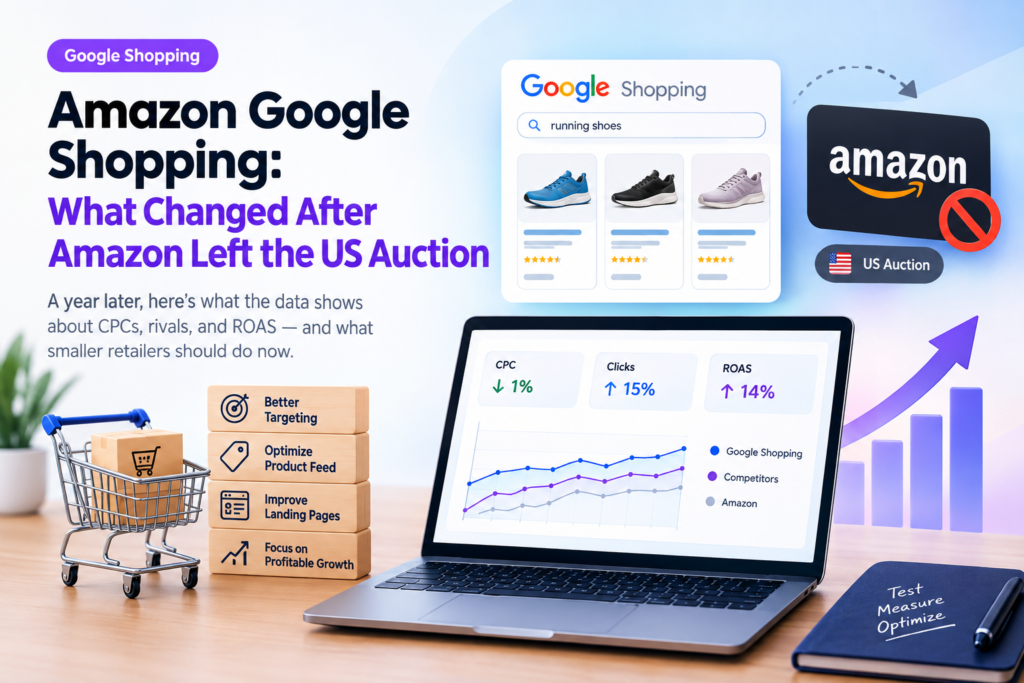
Longer-term data tells a calmer story. Tinuiti reported Google Shopping spend up 14% year over year in Q3 2025, clicks up 15%, and average CPCs down just 1%. Q4 looked similar.
Why so flat? Other retailers moved in fast. Temu came back in mid-July, Shein returned after about a month, and Walmart took a bigger share of impressions. Target grew during the holidays. The freed-up impressions got split across several big players instead of dropping into one advertiser’s lap.
One agency lead also pointed out early that Amazon appeared in about 30% of Shopping auctions across his client base, yet CPCs hadn’t dropped. That matches what I’d expect: a competitor leaving doesn’t guarantee a discount.
Why Amazon Might Have Stayed Away
Nobody outside Amazon knows. The most discussed theory is an incrementality test. Amazon already gets huge direct traffic, app traffic, and organic visibility. Turning off Shopping ads shows how many sales actually depended on them.
That’s a hypothesis, not a fact. Budget shifts, profit targets, or a change in its relationship with Google could also explain it.
There’s one more caveat. Amazon’s brand pull is unlike anyone else’s. If it can pause Shopping ads and hold steady, that says almost nothing about whether your Shopping ads are incremental. You have to test that yourself.
How I Review a Shopping Account When the Auction Shifts
I’ve seen the “more traffic, same sales” problem outside Shopping too. On one client site, organic traffic climbed but sales stayed flat. Most of the visits came from informational keywords, not buyers. Fixing it meant targeting high-intent searches, tightening landing pages, and making calls to action clearer.
Shopping works the same way. When clicks got cheaper but conversions didn’t improve, I stopped looking at CPC first. My review goes like this:
- Search terms. Find where low-value clicks come from and tighten targeting.
- Product-level performance. Cut spend on products that eat budget without converting.
- Conversion rate, conversion value, and ROAS. Read them next to CPC, never alone.
- Product feed and titles. Make sure they match what buyers actually search.
- Landing page, pricing, shipping info, and checkout. A great ad can’t fix a weak page.
- Budget shifts. Move money toward higher-intent products and away from the rest.
The Mistake I See Most Often
Advertisers raise budgets the moment a big competitor leaves. Lower competition can mean more chances, but not every extra click is worth buying. Scale only where the added traffic converts profitably.
What Small Retailers Should Do Now
Don’t try to beat Amazon on scale. Compete on relevance and profitability.
- Use your own Shopping data to spot products and searches you can realistically win.
- Keep your feed accurate and complete.
- Put budget behind high-intent traffic, not the highest click count.
- Watch auction sites and your CPCs, since Amazon’s US return could happen abruptly.
- Consider testing incrementality on one product category or region before making big budget calls.
FAQs
Is Amazon still off Google Shopping in the US?
Yes, as of Tinuiti’s Q2 2026 report, its US impression share against the median retailer is 0%. It returned in international markets within about a month.
Did CPCs fall after Amazon left?
Only slightly over the long run. Tinuiti saw about a 1% decline in Q3 2025, while Optmyzr’s early one-week snapshot showed 8.3%.
Should I raise my budget when a competitor leaves the auction?
Not automatically. Check search terms, conversion rate, and ROAS first, then scale what’s profitable.
Will Amazon come back?
Nobody outside Amazon can say. Track impression share and CPC trends so you can react quickly.
Conclusion
A year on, the Amazon Google Shopping story is less about a gold rush and more about a lesson. Cheaper clicks are easy to celebrate, but revenue is what pays the bills. Review your search terms, product performance, and conversion path, spend where the traffic is qualified, and test before you assume.
As a best digital marketing expert in Thrissur, I help businesses improve their online visibility through SEO, social media marketing, content strategy, and website optimization. My goal is to create practical, result-focused digital marketing strategies that help businesses reach the right audience and grow online.