Table of Contents
Primary keyword: AI visibility
Meta description : AI visibility at scale: what 9M prompts and 400+ enterprise brands reveal about getting mentioned in AI answers, and the fixes you can make this month.
URL slug: /ai-visibility-at-scale-9m-prompts-enterprise-brands
Most marketers assume big brands win in AI answers. It sounds logical. More mentions across the web should mean more mentions in ChatGPT, Google AI Mode and Gemini.
But when you study AI visibility across 9 million prompts and 400+ enterprise brands, that assumption starts to crack. Some household names barely show up. Smaller, lesser-known brands get named again and again.
I’ve seen the same thing with my own clients. In this post, I’ll explain what really shapes AI visibility, the mistakes I run into most often, and a simple process you can start using this month.
What AI visibility actually means
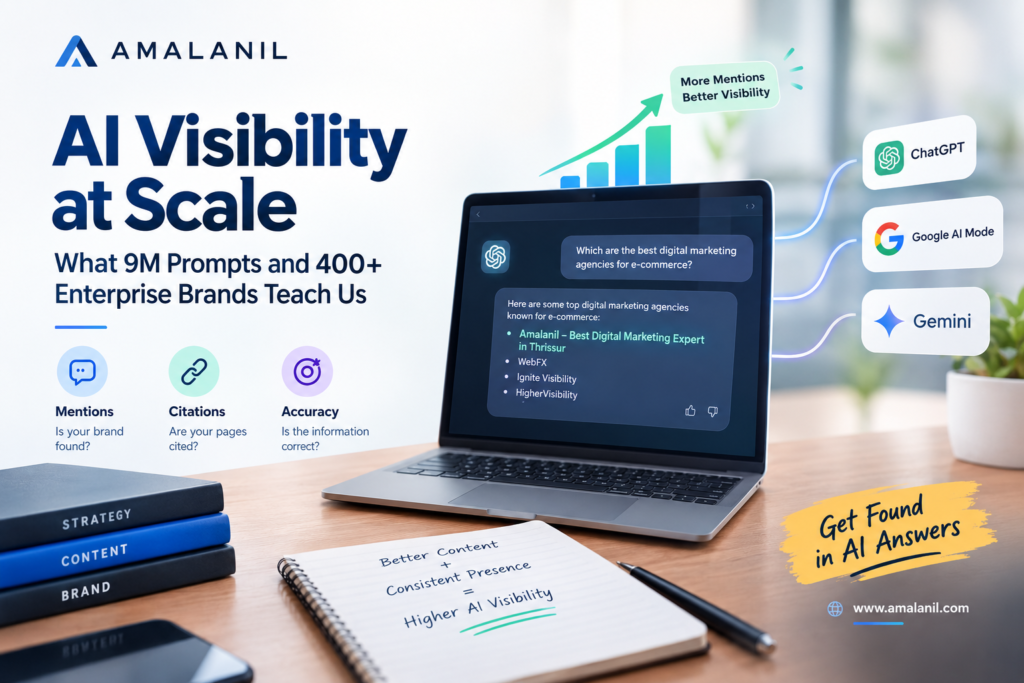
The visibility of your AI visibility here means how often or accurately your brand name is mentioned in the results of searches in artificial intelligence. This metric includes three main indicators:
Mentions – if your brand name is found;
Citations – if your web pages are cited;
Accuracy – the correctness of the search results and context.
The ratio of the first two indicators is what interests many companies. And here, it turns out, that only one in five brands “makes it big.” Semrush conducted an experiment and explored over 2500 queries in ChatGPt and Google AI Mode to see how often companies’ brands are mentioned and cited in AI responses. The results showed that while brand mentions were relatively high, citations were low, and the accuracy was lower than expected.
Does brand size decide who wins in AI answers?
Partly, yes. A 2026 research paper on arXiv looked at 100,000+ AI responses across 100+ brands. Global household names showed up in 73% of relevant answers on the first run. Mid-market brands appeared in 44%, and small niche brands in only 11%. So size gives you a head start on average.
A head start isn’t a guarantee, though. On one project, I worked with a smaller business that had a much stronger presence in AI answers than some larger competitors. Hardly anyone knew the brand. What it did have was clear service pages, detailed educational content, and the same facts repeated across its website and other trusted sources. Over time, it appeared more often in AI-generated answers for relevant queries.
One client is not a study, and results vary by industry and platform. Still, it matches what I keep seeing. AI tools tend to favor brands that are easy to understand and easy to verify.
| Factor | Helps when… | Hurts when… |
| Brand recognition | People already search for and write about you | You assume fame alone will carry you |
| Page content | Pages answer real customer questions clearly | Pages are vague, thin or built around keywords |
| Information across sources | Facts match on your site and third-party sources | Descriptions conflict from one source to the next |
Why one-off checks fool you
Typing your brand into ChatGPT https://en.wikipedia.org/wiki/ChatGPT once tells you very little. An AI answer is a single sample, not a fixed ranking. Ask the same question twice and you can get different brands.
That’s why serious AI visibility tracking uses a fixed set of prompts, run on a schedule. If you change the prompts halfway through, you break the trend line. LLM Pulse has a good write-up on this.
It also helps to split branded prompts from non-branded ones. Branded prompts flatter you, because the AI is already being asked for you by name. The non-branded prompts show where you really stand against competitors.
The three mistakes I see most often
1. Treating AI visibility like keyword SEO
This is the big one. Brands write for search engines and forget to answer the actual question. Repeating a keyword ten times doesn’t help an AI system understand what you do. A clear, direct answer does.
2. Letting information drift across sources
Your website says one thing. A directory says another. An old press mention says a third. When the facts don’t match, AI tools have less reason to trust any of them. Consistency across your own pages and trusted third-party sources matters more than most people expect.
3. Tracking only the prompts that make you look good
Measurement specialists flag this too. If you only test queries that include your brand name, your numbers will look healthy while real discovery queries go unchecked. Add the plain, problem-led questions your customers type when they don’t know you yet.
A simple process to improve AI visibility
Here’s the order I follow with clients.
- List the questions that matter. Pick the customer queries tied to real revenue, not vanity topics.
- Check where you stand today. Are you mentioned? Which sources get cited? How are competitors described?
- Audit for gaps and conflicts. Review your website, your content and third-party mentions side by side.
- Fix the answer pages first. Make the pages that respond to your top questions clear, specific and well structured.
- Strengthen the supporting sources. Update profiles and listings, and earn mentions on sites AI tools already cite.
- Re-check on a schedule. Run the same prompt set weekly or monthly and compare.
If you can fix only one thing this month
Improve the pages that directly answer your customers’ most important questions. Skip the keyword tricks. Make each page clear, specific and genuinely useful. Strong answer-focused content gives AI systems cleaner information to work with, which improves your chances of being mentioned.
How to measure whether it’s working
I track a handful of signals together:
- How often the brand appears across a defined set of relevant queries
- The accuracy and context of each mention
- Which pages and third-party sources get cited
- Changes in brand mentions over time
- Referral traffic from AI platforms, where it can be measured
- Whether those visits lead to meaningful actions, like enquiries or sign-ups
A caution on that traffic point: AI referrals are often undercounted, so treat the number as a floor, not the full picture. And don’t lean on any single metric. Visibility without business impact is a nice screenshot. Impact without visibility data leaves you guessing why it happened.
FAQs
What is an AI visibility?
It defines how frequently and accurately your brand is cited in responses generated by AI such as ChatGPT, Gemini, Google AI Mode, etc.
Does bigger always means better in terms of building visibility within AI?
While having a bigger brand name always helps, proper optimization makes smaller companies competitive within AI space. On average bigger companies are more likely to appear in the responses due to their higher profile, but clear and consistent information may significantly increase display probability for any company
How is it different from SEO?
SEO optimization focuses on making sure that pages with product or service descriptions appear in the search results when a user queries a relevant term. With AI the focus is on making sure that the systems actually recognize, reference and trust the brand. The principles are similar but achieving visibility within AI requires more emphasis on the degree of detail and helpfulness of the information provided.
How often should one check and optimize for AI visibility?
For most companies checking every week or month is sufficient to see if any changes have occurred. It is important to keep the same prompts every time in order to evaluate progress correctly
How long does it typically take to optimize one’s presence within AI?
It depends on the company, industry and platform. In the example above the optimization efforts had a noticeable impact on the performance, but it took time to fully unfold and become apparent
Conclusion: takeaways for the reader
While the initial test strongly suggests that bigger companies have better chances of success, the outcome is not predetermined. Other factors, such as level of detail, consistency of information provided and overall value to the consumer also matter.
As a best digital marketing expert in Thrissur, I help businesses improve their online visibility through SEO, social media marketing, content strategy, and website optimization. My goal is to create practical, result-focused digital marketing strategies that help businesses reach the right audience and grow online.