
Table of Contents
Meta Description: Online ads vs offline ads: which one fits your business? How to decide by goal, audience, budget and tracking with practical tips for local owners
URL Slug: /online-ads-vs-offline-ads
Primary Keyword: online ads vs offline ads
Secondary Keywords used: online advertising vs offline advertising, digital ads vs traditional ads, online vs offline marketing, advertising for local business, best advertising for small business, benefits of online advertising, offline advertising examples
Online Ads vs Offline Ads: Which Is Better for Your Business?
Most business owners ask the wrong question when it comes to online ads vs offline ads. They are presented with a choice between two options and wonder which one is universally better. The right question should be: which one fits my goals, audience, budget, and tracking capabilities?
As an SEO and digital marketing https://en.wikipedia.org/wiki/Digital_marketing consultant, I speak with business owners about their advertising regularly. Some are convinced that they should only use digital means, as it seems modern. Others are set on flyers and signs, because they have always used them. Both approaches are wrong in their own way. Here is how I would actually approach the choice between online advertising vs offline advertising, and how you can too.
What Are Online and Offline Advertising?
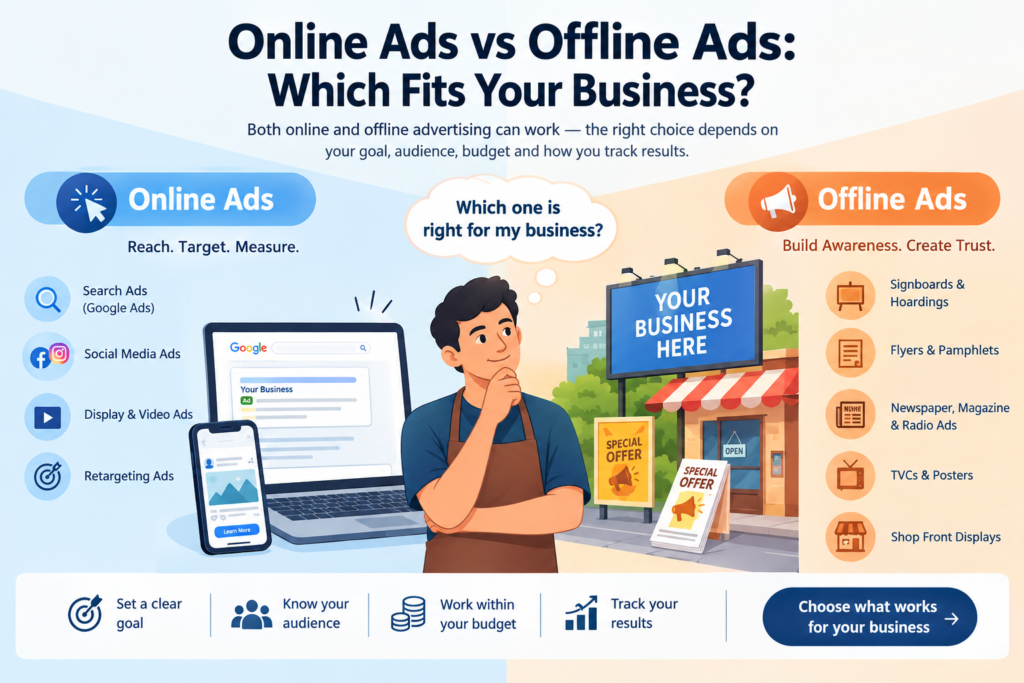
In the comparison of online ads vs offline ads, the comparison is different from the meaning. Online advertising also called digital advertising refers to the use of Internet to market products or services to meet a target audience on the virtual space. On the other hand, offline advertising encompasses all the other ways that had been in use to advertise products and services that do not require the use of the Internet as the platform.
Examples of online advertising:
Google Ads and other search engine marketing
Social media advertising
Display and video ads
Retargeting
Examples of offline advertising:
Signboards and hoardings
Flyers and pamphlets
Newspaper, magazine and radio advertising
TVCs and posters
What Are Online and Offline Advertising?
Think of them as two different tools. Each does a different job, and neither is right or wrong by default. Online advertising reaches people through the internet, on Google, social media, websites and apps. Offline advertising reaches them in the real world, through signboards, flyers, newspapers, radio and similar formats.
Before you compare online ads vs offline ads, work out what you want the campaign to achieve and how you’ll measure it. That keeps the choice tied to what your business needs, not to guesses.
Online Ads vs Offline Ads: Quick Comparison
| Factor | Online advertising | Offline advertising |
| Targeting | More options: location, interests, demographics and search intent | Depends mostly on where the ad is placed |
| Measurability | Easier to track clicks, calls, leads and conversions | Harder to measure; may need QR codes or unique offers |
| Budget | Usually easy to start, pause and adjust | Often needs a bigger upfront or longer commitment |
| Local reach | Can target specific areas and audiences | Reaches people who regularly pass through an area |
| Best for | Lead generation, sales, testing and measurable campaigns | Local visibility and awareness |
Why Choosing the Channel First Is a Mistake
The mistake I see clients make most often is picking a channel before they’ve thought it through. Maybe it’s a personal belief, maybe it’s something a specialist said, and then the whole budget goes in one direction.
I’d flip that order. Look at your offer, your target audience and your budget first. The channel comes after.
When to Choose Online Advertising
Online works best when you need to reach a specific audience and see what your money is doing.
- Your audience is spread out. Instead of handing out flyers to everyone in an area, you can reach the people who are actually likely to buy.
- You need measurable results. Offline ads are hard to track. Digital campaigns show you clicks, impressions, leads and conversions.
- Your budget is small and you want to test. Start with a little, see what performs, then put more behind the winner.
- Your customers are already online. If they search on Google or spend time on social media, you can meet them there.
When to Choose Offline Advertising
Offline can be a strong option for local businesses, because it helps people in the area recognise and remember you.
It’s worth considering if:
- you run a local shop, clinic, restaurant or service and want an eye-catching signboard or storefront display
- your audience regularly passes through a particular area and will see your flyers, posters or outdoor ads
- your budget is limited and you want repeated visibility in one neighbourhood
- you want to build brand recognition and trust in your local community
When Offline Advertising May Not Be the Best Fit
It doesn’t suit every business. Be careful if:
- Your customers live in different areas. Placing signs everywhere gets expensive fast.
- You need measurable results. Offline is hard to track unless you add QR codes, unique offers or dedicated contact details.
- Your budget is tight. Flyers, newspaper ads and signboards add up quickly when you repeat them across locations.
Final Check Before You Decide
Look at your audience, your campaign goal, your budget and how you’ll measure results. Answer those four honestly and the online ads vs offline ads decision usually gets much clearer for your business.
How to Choose: A Practical Guide
In order to actually understand how to choose between online advertising vs offline advertising, let’s make a shortlist of factors that you would need to consider.
Choose a single goal. Set a certain action as your conversion, such as phone calls, WhatsApp enquiries, or store visits.
Define your audience. Know who you are talking to, where they are, and what they are interested in.
Set your budget. If you cannot measure the impact of your advertising, it is best to keep it small until you get more information.
Test and optimize. With the goal and audience in mind, as well as the budget, you will be able to design a simple experiment. For example, you can take a small portion of your advertising budget and run a targeted online ad campaign, set up a specific landing page for it, and track how many leads or sales it gets. Similarly, you can try running a small-scale offline advertising campaign and track your results.
This approach works for everyone, and is a great starting point for beginners who want to find the best advertising for small business. It should give you some valuable information on how to find the best advertising for small business with a limited budget.
How to Measure Offline Advertising Effectiveness
Offline advertising examples cannot always be measured directly, but there are ways to get useful statistics.
For each of your campaigns, set up a unique way to collect information. For offline advertising, that can be a QR code that leads to a landing page, a WhatsApp or phone number to send enquiries, an offer that is only available to those who know about the campaign, and so on. For online advertising, set up tracking links and utilize Google’s conversion tracking resources, as described in their guide.
Once you have set up tracking for your advertising campaign, you will be able to see how much you spend on it in relation to the number of leads, sales, or other actions. Using the information, you can compare the effectiveness of your online advertising vs offline advertising campaigns. Ultimately, it comes down to cost per lead, number of leads, sales, and overall value. In this case, ten unqualified leads will not be as useful as ten leads that turn into actual sales.
How to Use Both Offline and Online Advertising
Online advertising vs offline advertising is not always mutually exclusive, and in some cases, using both offline and online advertising can actually be the best option.
Using both types of advertising is useful if you want to build a strong presence in a local area. For example, an offline advertising campaign may get customers to search for your business online or request more information via WhatsApp. At the same time, your online advertising campaign may get you valuable inquiries that are easy to measure and optimize. Thus, it is important to realize that online vs offline marketing are not always opposing forces.
If you do use both, make sure that each campaign has its own tracking system. This will allow you to see which channels actually bring you sales and are worth investing in. It will also help you understand how online advertising compares to offline advertising, and which one brings you better results.
Where to Start if You Have a Small Business Budget
If you own a local business and have never tracked your offline advertising campaigns, it is best to start with a small experiment. You should not put a large chunk of your advertising budget into one channel blindly, simply because it is popular. Here is how to actually start with a small advertising campaign, regardless of whether it is online or offline.
Pick your goal. It is important to know what you want to achieve with your advertising campaign. That goal should be something that you can track, such as calls, WhatsApp enquiries, or sales. Thus, you will know what advertising channel works best for you.
Get some baseline data. You need to have a way to track your advertising campaign, even if it is something as simple as a phone number for enquiries. Once you have it, you can actually see how your advertising performs.
Run a test advertising campaign. You can start with a small budget for either online or offline advertising. For online advertising, the campaign should have a specific landing page to collect leads or sales. For offline advertising, you can get creative and use a QR code to a website, a unique WhatsApp number, an offer that is only available to those who know about the campaign, or any other unique identifier.
Analyze and optimize. Once you have the data from your advertising campaign, assess its value. Look at how much you spent on it in comparison to the number of leads, sales, or other actions. Then, you can decide whether it is worth expanding the campaign or optimizing it.
These are some general recommendations for new advertising campaigns. Ultimately, how to choose between online advertising vs offline advertising depends on your specific circumstances.
FAQs
Which is better, online ads or offline ads?
The choice between online ads vs offline ads depends on the situation. Online advertising typically provides better targeting options and measurability, while offline advertising can be more useful for local audiences. You will need to consider your own circumstances when deciding which one is better for your business.
Are offline ads still worth it?
Offline ads examples can be worth it, depending on your audience and goals. If you are targeting a local audience, you may find that signs and flyers are a good fit for you. However, you should always track your advertising to ensure that it gets you inquiries or sales.
Can I use online and offline ads together?
Yes, you can use online and offline ads together. In most cases, it is a good idea to track each campaign separately in order to understand which one gets you the most value. This way, you will be able to optimize your advertising budget.
How do I measure offline advertising?
There are several ways to measure offline advertising. You can track leads and sales from each campaign, set up a QR code to a landing page, set up a separate WhatsApp or phone number, and more.
What’s the difference between digital and traditional advertising?
Digital advertising includes all the marketing tools that use the Internet, such as Google Ads, social media, display ads, and retargeting. Traditional advertising includes all the other types of advertising, such as newspaper, magazines, TVCs, radio, flyers, and signs.
Looking for the Best Digital Marketing Expert in Thrissur? I help businesses improve their online visibility, reach the right audience, generate quality leads, and grow through SEO, social media marketing, Google Ads, content marketing, and website optimization.