Table of Contents
primary keyword: OpenAI users won’t click links
Meta Description: A court filing says OpenAI users won’t click links, even prominent ones. Here’s what that means for SEO, AI referral traffic, and your content strategy.
URL Slug: /openai-users-wont-click-links
OpenAI Users Won’t Click Links: What the Court Filing Means for SEO
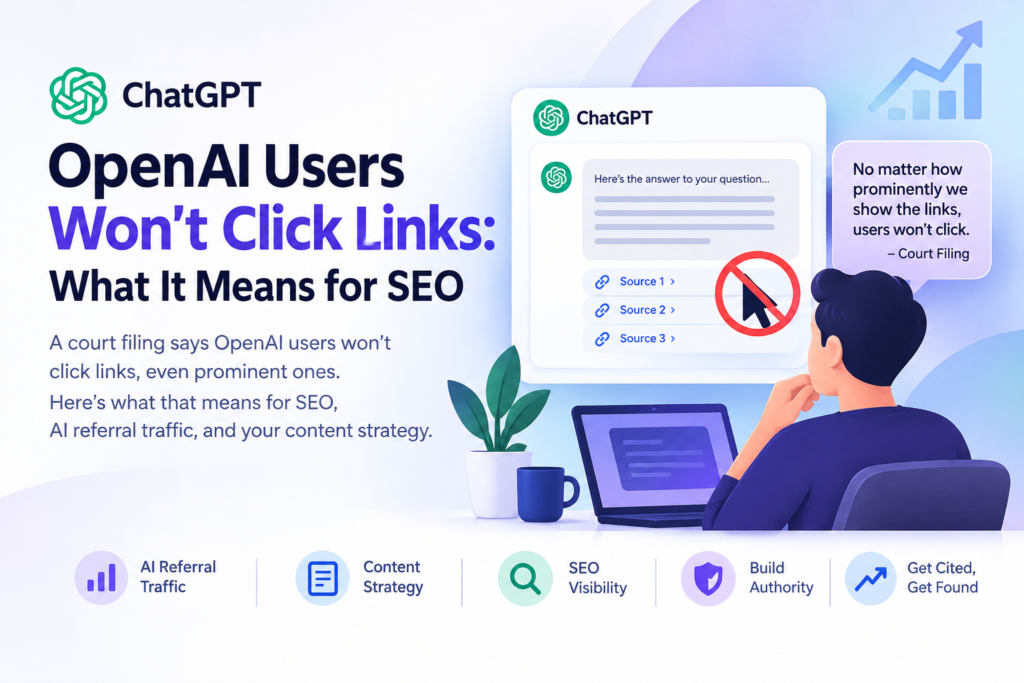
A single line from a court filing is making the rounds in SEO circles. A brief from news publishers suing OpenAI and Microsoft quotes an engineer who reportedly said “no matter how prominently we show the links, users won’t click.” The message dates back to February 2023.
If you work in SEO, that sentence stings. It suggests OpenAI users won’t click links, even when the links sit right there in the answer. So is search traffic about to disappear?
I don’t think so. But the way we measure visibility in AI search is changing, and it’s worth understanding how. Below, I’ll break down what the filing says, what I see in AI referral traffic, and how I’d adjust a content strategy today.
What the Court Filing Actually Says
Let’s separate the headline from the facts.
- The filing comes from news publishers suing OpenAI and Microsoft, and The New York Times reported that the engineer wrote the message in February 2023.
- The same brief cites Nick Turley, OpenAI’s head of ChatGPT, saying users had little reason to visit the original source once ChatGPT https://en.wikipedia.org/wiki/ChatGPT gave an answer.
- The publishers also point to Microsoft data showing lower click-through rates in Bing Chat than in Bing web search.
Now the caveat. This is one side’s argument, and the court hasn’t ruled on it. OpenAI and Microsoft argue that training on copyrighted material creates new content and doesn’t replace journalism. So treat the quotes as evidence in a lawsuit, not as a verdict on user behavior.
AI search can break that loop because an AI answer can often satisfy the user’s question without requiring another click.
Classic SEO ran on a simple loop. You rank, people click, and you earn traffic. AI answers break that loop because the answer often ends the search.
That’s why this filing matters even if the lawsuit goes nowhere. It puts an old worry into plain words. If the answer is good enough, the source becomes optional.
Still, I wouldn’t panic. My first move is always the same: check the data. Look at search behavior, rankings, traffic, and conversions before deciding whether this is a real hit or just a shift in how people find you.
What I See in AI Referral Traffic
I’ve started watching AI referrals closely, especially visits coming from tools like ChatGPT. The pattern so far is consistent. The volume is smaller than traditional Google traffic, but the visitors are often more engaged.
That makes sense. Someone who clicks after reading an AI answer usually wants something specific. They aren’t browsing. They’re checking, comparing, or ready to act.
Your results will vary by industry, so don’t copy my read blindly. Here’s how the two channels tend to differ:
| Factor | Google organic | AI referrals |
| Volume | Larger | Usually smaller |
| Visitor intent | Mixed | Often specific and focused |
| Main goal | Rank and earn the click | Get cited, referenced, and trusted |
| What to track | Rankings, clicks | Referrals, engagement, assisted conversions, brand mentions |
The takeaway is simple. Don’t judge AI traffic by volume alone.
Should You Still Publish Content If People Won’t Click?
Yes. But the role of content in AI search has to evolve.
When a client asks me this, I tell them content still does real work even without a click. It builds visibility and brand awareness. It earns citations. It also helps potential customers understand what the business actually does.
So I stop asking, “How much traffic did this post get?” Instead, I ask three questions:
- Did it reach the right audience?
- Did it build trust?
- Did it contribute to conversions?
The Biggest Mistake Businesses Make With AI Search
AI search systems need content that is clear, accurate, structured, and genuinely useful. Businesses obsess over keywords and rankings and forget the basics.
AI search systems need content that is clear, accurate, structured, and genuinely useful.. So focus on answering real customer questions. Keep your information structured and up to date. And build brand authority beyond your own website.
A 5-Step Process to Get Visible in AI Answers
Here’s the simple process I follow with clients:
- Find the questions. Identify what customers ask in AI tools and in traditional search.
- Create useful answers. Write clear, direct content that beats generic pages on the same topic.
- Strengthen the website. Improve internal linking, structure, schema, author and business details, and trust signals.
- Build authority. Earn mentions on relevant, credible websites and platforms.
- Measure visibility. Track AI referrals, brand mentions, search performance, and conversions. Then improve based on what you see.
The goal isn’t to “rank in AI.” It’s to make your business easy for search systems to understand, trust, and reference.
Frequently Asked Questions
Does this mean SEO is dead?
No. AI search isn’t replacing SEO. It’s changing what visibility looks like. It’s changing what visibility looks like. Strong content, clear structure, and trust signals still matter, and they now feed AI answers too.
Is AI referral traffic worth tracking?
Yes. It’s usually smaller than Google traffic, but it can bring more engaged visitors. Track it alongside engagement and conversions, not just sessions.
How do I measure success if clicks drop?
Look beyond clicks. Watch AI referrals, brand mentions, search performance, and assisted conversions together. That gives a fuller picture of whether your content is working.
Conclusion: Chase Trust, Not Just Clicks
The claim that OpenAI users won’t click links is still just one side’s argument in a lawsuit. But it points at something real. In AI search, visibility is no longer only about the click.
So here’s what I’d do this week. Check your AI referral traffic, list the questions your customers ask, and tighten the pages that answer them best. Become the source AI systems can understand, reference, and recommend.
Looking for the Best Digital Marketing Expert in Thrissur Amal Anil helps businesses improve their online visibility through SEO, social media marketing, content marketing, Google Ads, and website optimization. With practical, goal-focused strategies, the aim is to attract the right audience, generate quality leads, and support sustainable online growth.